
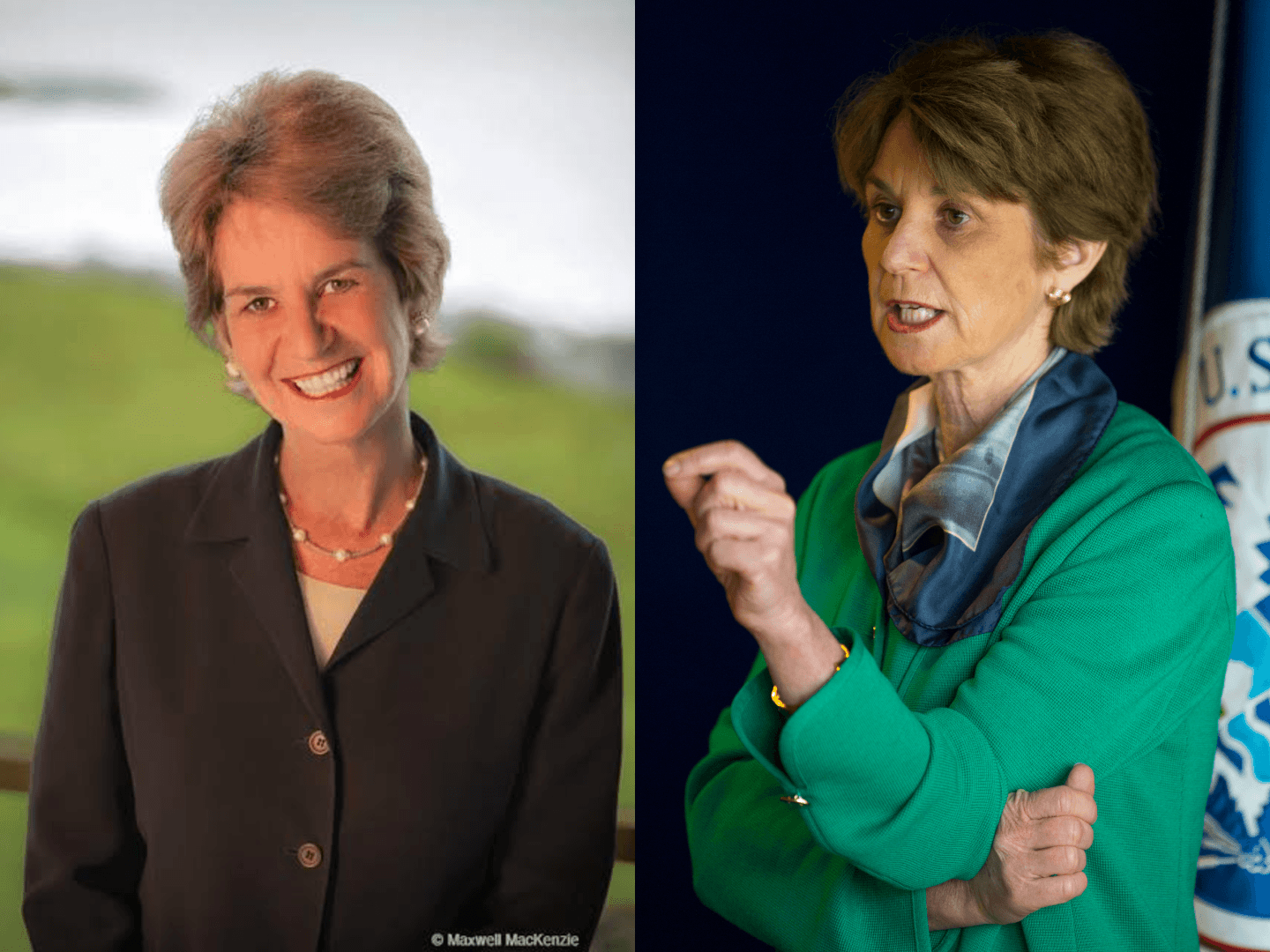
Kathleen Kennedy Townsend is the eldest child of Robert F. Kennedy and a former Lieutenant Governor of Maryland who served from 1995 to 2003. She was the first woman to hold that office and has built a career defined by public service, criminal justice reform, and retirement security advocacy that extends well beyond her famous family name.
Born Kathleen Hartington Kennedy on July 4, 1951, in Greenwich, Connecticut, she entered the world as the first of eleven children born to Robert F. and Ethel Skakel Kennedy . She was named after her aunt, Kathleen Agnes Kennedy, who died in a plane crash in the 1940s. The Kennedy political dynasty shaped her upbringing, but Townsend would eventually forge her own distinct identity in public service.
Early Life and Education
Townsend spent most of her childhood in McLean, Virginia, though she attended school in nearby Montgomery County, Maryland. She graduated cum laude from Harvard University’s Radcliffe College in 1974 with a Bachelor of Arts degree in history and literature . She then pursued a law degree at the University of New Mexico School of Law, where she was a member of the law review and earned her Juris Doctor in 1978 .
She was admitted to the Maryland bar in January 1985 and began building a legal career that included serving as an instructor at several institutions, including the University of Pennsylvania, Essex Community College, and Dundalk Community College . Her early professional work demonstrated a commitment to public service that would define her entire career.
Founding the Maryland Student Service Alliance
Before entering high office, Townsend founded the Maryland Student Service Alliance, a public-private partnership with the State Department of Education that made Maryland the first and still only state to require community service for high school graduation . This initiative demonstrated her belief in civic engagement and youth development, principles she would carry throughout her political career.
The Alliance also launched Civic Works, an urban service corps that put young adults to work while teaching critical job skills . This early success established Townsend as an innovator in education and community development.
Early Political Career and Congressional Run
In 1986, Townsend ran for Congress in Maryland’s second congressional district. She lost to Helen Delich Bentley, receiving 41 percent of the vote to Bentley’s 59 percent . The loss made her the first Kennedy to lose a general election. Rather than retreat from public life, she continued serving in various government roles, including assistant attorney general for Maryland from 1985 to 1986 .
She served as a senior advisor to the Appropriations Committee in the Maryland House of Delegates and became a presidential elector in 1992 . Her experience in state government prepared her for the responsibilities that lay ahead.
Deputy Assistant Attorney General
From 1993 to 1994, Townsend served as Deputy Assistant Attorney General of the United States under the Clinton administration . In this role, she was responsible for a billion-dollar budget supporting local law enforcement and helped organize the training of 100,000 community police officers . She also helped initiate the Police Corps, a program designed to bring college-educated recruits into law enforcement.
This federal experience gave her national exposure and demonstrated her capability in managing large-scale government programs. She was establishing herself as a serious policy expert, not merely a political figure riding on family connections.
Lieutenant Governor of Maryland
In 1994, Parris Glendening selected Townsend as his running mate in the Maryland gubernatorial election. Her selection was widely credited with giving the campaign national support and helping win the Democratic primary . The Glendening-Townsend ticket won the general election against Republican Ellen Sauerbrey in one of Maryland’s closest and most controversial gubernatorial elections. The same tickets squared off again in 1998, with a wider margin of victory for the Democrats .
As Lieutenant Governor from January 18, 1995, to January 15, 2003, Townsend became the first woman to hold that office in Maryland history . She chaired the Cabinet Council on Criminal and Juvenile Justice, a body that included nine cabinet secretaries and the Attorney General . This position allowed her to implement significant criminal justice reforms.
Criminal Justice Reform Initiatives
Townsend spearheaded the establishment of Operation Maryland Cease Fire and the Maryland Community Policing Academy, the first training program of its kind in the nation . The academy trained police officers and citizens together, building trust necessary to shut down open-air drug markets and reduce crime. Cease Fire became the first state police unit dedicated to targeting illegal gun traffickers, confiscating more than 600 assault weapons and other illegal firearms by 1996 .
She developed the Hot Spots initiative, which reduced crime by 33 percent over three years in Maryland’s highest crime communities . Former Attorney General Janet Reno praised the program as a national model. Townsend also helped craft juvenile justice legislation that expedited the court process, required police to notify schools when students were arrested for serious offenses, and doubled the amount of restitution juveniles could be ordered to pay to victims .
The lieutenant governor required all state employees to undergo domestic violence training and co-chaired the Family Violence Council, which developed stronger laws and programs to protect victims and hold abusers accountable . She also worked to tighten Maryland’s drunk driving laws, making convictions easier to obtain for motorists caught with blood-alcohol levels of .10 or above .
Education and Youth Initiatives
Education remained a priority throughout Townsend’s tenure. She launched Character Education in public schools and expanded after-school activities to keep children engaged and off the streets . She also served as chair of the Advisory Board on After-School Opportunity Programs and the Maryland Partnership for Children, Youth, and Families .
She helped reform the juvenile justice system to hold young offenders accountable while also focusing on prevention. The Task Force on Youth Citizenship and Violence Prevention developed initiatives to improve character education, remove disruptive students from classrooms, and encourage greater parental responsibility .
The 2002 Gubernatorial Campaign
In 2002, Townsend ran for Governor of Maryland as the Democratic nominee against Republican Bob Ehrlich. Her choice of running mate, retired Admiral Charles Larson, came under criticism because he was a novice politician who had switched parties only weeks before the election . In contrast, Ehrlich’s running mate was Michael Steele, an African-American lawyer who had been chairman of the Maryland Republican Party.
Townsend’s campaign was also hurt by the unpopularity of Governor Parris Glendening, who had implemented a partisan redistricting proposal overturned by Maryland’s highest court . Reports that much of her campaign money came from out-of-state donors further weakened her position. Despite Maryland’s historical tendency to vote Democratic, Townsend lost the race, receiving 47.7 percent of the vote to Ehrlich’s 51.6 percent . She became the first Kennedy to lose a statewide election, and many observers concluded she ran a weak campaign.
Post-Elective Career and Retirement Advocacy
After her political career, Townsend transitioned to the private sector as a Managing Director at the Rock Creek Group, one of the largest women-owned asset management firms in the United States . The firm counted state, corporate, and union pension funds among its clients. This experience gave her firsthand insight into retirement security issues.
She became Director of Retirement Security at the Economic Policy Institute from 2018 to 2019 and founded the Center for Retirement Initiatives at Georgetown University’s McCourt School of Public Policy . She chaired the Maryland Task Force on Retirement Security, which led to the creation of Maryland Saves, a state-facilitated retirement savings program . When the Center opened, not a single state had passed auto-IRA legislation, but 18 states have since enacted retirement reform .
Townsend served as the Secretary’s Representative on Pensions and Retirement at the U.S. Department of Labor under President Biden, leading the retirement reform campaign for Secretary Marty Walsh . Her work in this area has had a measurable impact on millions of Americans who previously lacked access to retirement savings options.
Human Rights and Global Health Work
Townsend has maintained strong involvement in human rights and global health initiatives. She founded the Robert F. Kennedy Human Rights Award, which honored Lech Walesa, Bishop Desmond Tutu, and the Co-Madres from El Salvador, among many others . She also chaired the Robert Kennedy Memorial and served on the board of the John F. Kennedy Library Foundation .
She chaired the Institute of Human Virology, founded by Dr. Robert Gallo, which treats over one million patients in Africa as part of the PEPFAR program . She also chaired the Global Virus Network and served as Vice-Chair of the Future of Science conference in Venice, Italy, helping make stem cell research acceptable in Italy .
Academic and Board Service
Townsend has served as a Woodrow Wilson Fellow and taught foreign policy at the University of Pennsylvania and the University of Maryland . She has been a visiting Fellow at Harvard’s Kennedy School of Government and an adjunct professor at the Georgetown Public Policy Institute . She has received fourteen honorary degrees in recognition of her contributions to public service and policy .
She has served on numerous boards, including the Export-Import Bank, Johns Hopkins School of Advanced International Studies, the Points of Light Foundation, the Wilderness Society, the Center for American Progress, and the National Institute for Women’s Policy Research . She is also a member of the Council on Foreign Relations and the Inter-American Dialogue .
Author and Public Intellectual
In 2007, Townsend published her book “Failing America’s Faithful: How Today’s Churches Mixed God with Politics and Lost Their Way” . The book examined the intersection of religion and politics, reflecting her interest in how faith communities engage with public life. She has also written for The Recovering Politician website and contributed to public discourse on retirement security and criminal justice .
Personal Life and Family Tragedy
Townsend married David Lee Townsend in 1973, and they have four daughters: Meaghan Anne Kennedy Townsend (born 1977), Maeve Fahey Kennedy Townsend (born 1979), Rose Katherine Kennedy Townsend (born 1983), and Kerry Sophia Kennedy Townsend (born 1991) . David Townsend is a faculty member at St. John’s College in Annapolis .
Tragedy has struck the family multiple times. On April 2, 2020, her daughter Maeve and her eight-year-old grandson Gideon died in a canoeing accident in the Chesapeake Bay . They had gone to recover a ball that had landed in the water near Townsend’s home in Shady Side, Maryland. High winds swept their canoe into the bay, and both drowned. Maeve’s body was recovered after a four-day search, and Gideon’s body was found two days later .
Townsend also experienced the loss of her father, Robert F. Kennedy, who was assassinated in 1968 when she was just 16. Her brother David died of a drug overdose in 1984, and her brother Michael died in a skiing accident in 1997 .
Family Rift and Recent Years
In recent years, Townsend has become estranged from her brother Robert F. Kennedy Jr. following his endorsement of Donald Trump in the 2024 presidential election and his subsequent appointment as Secretary of Health and Human Services . She and four of her siblings endorsed Kamala Harris’s campaign and denounced their brother’s decision, calling it a “betrayal” . The rift has fractured the Kennedy family, with virtually no contact between Townsend and RFK Jr .
In May 2026, Townsend sold her Hyannis Port property for $1.6 million . She had purchased the home for $1.275 million in 2023 with dreams of recreating the summers of her youth for her children and grandchildren . She told the Boston Globe that her surviving children did not feel drawn to the Cape, and family awkwardness had made reunions fraught . “I had this wonderful dream. But not all dreams work, right?” she said .
Legacy and Impact
Kathleen Kennedy Townsend has built a legacy that stands on its own merits. As Maryland’s first female Lieutenant Governor, she pioneered criminal justice reforms that became national models . Her work on community policing through the Hot Spots initiative demonstrated that targeted law enforcement could significantly reduce crime. Her advocacy for retirement security has helped 18 states enact legislation making it easier for workers to save for their senior years .
She has carried forward her father’s commitment to public service while forging her own distinct path through law, government, finance, and advocacy. Despite the weight of the Kennedy name and its associated tragedies and expectations, Townsend has proven herself a capable and dedicated public servant. Her career demonstrates that she is not merely a Kennedy by birth but a policy innovator whose work has touched millions of lives across multiple domains.What is Kathleen Kennedy Townsend best known for?
Kathleen Kennedy Townsend is best known as Maryland’s first female Lieutenant Governor, serving from 1995 to 2003 . She also founded the Maryland Student Service Alliance, making Maryland the first state to require service-learning for high school graduation . She later became a leading advocate for retirement security, launching Maryland Saves and co-founding the Center for Retirement Initiatives at Georgetown University .
How is Kathleen Kennedy Townsend related to the Kennedy family?
She is the eldest child of Robert F. Kennedy and Ethel Kennedy, making her a niece of President John F. Kennedy . She is the oldest living member of the storied political dynasty .
Did Kathleen Kennedy Townsend run for governor?
Yes, she ran as the Democratic nominee for Governor of Maryland in 2002 . She lost to Republican Robert L. Ehrlich Jr., receiving 47.68% of the vote to Ehrlich’s 51.55% .
What is the Maryland Student Service Alliance and why is it important?
The Maryland Student Service Alliance was founded by Townsend in the late 1980s . It successfully led the effort for Maryland to become the first and only state to make service-learning a high school graduation requirement . Townsend developed curricula for grades K-12 and trained over 2,000 teachers in service-learning techniques .
What is Townsend’s role in retirement security reform?
Townsend chaired the Maryland Task Force on Retirement Security, which led to the creation of Maryland Saves . She co-founded the Center for Retirement Initiatives at Georgetown University to help states enact auto-IRA legislation . When the Center opened, no state had passed such legislation; now 18 states have enacted retirement reform . She also served as Secretary’s Representative on Pensions and Retirement at the U.S. Department of Labor under President Biden .
