
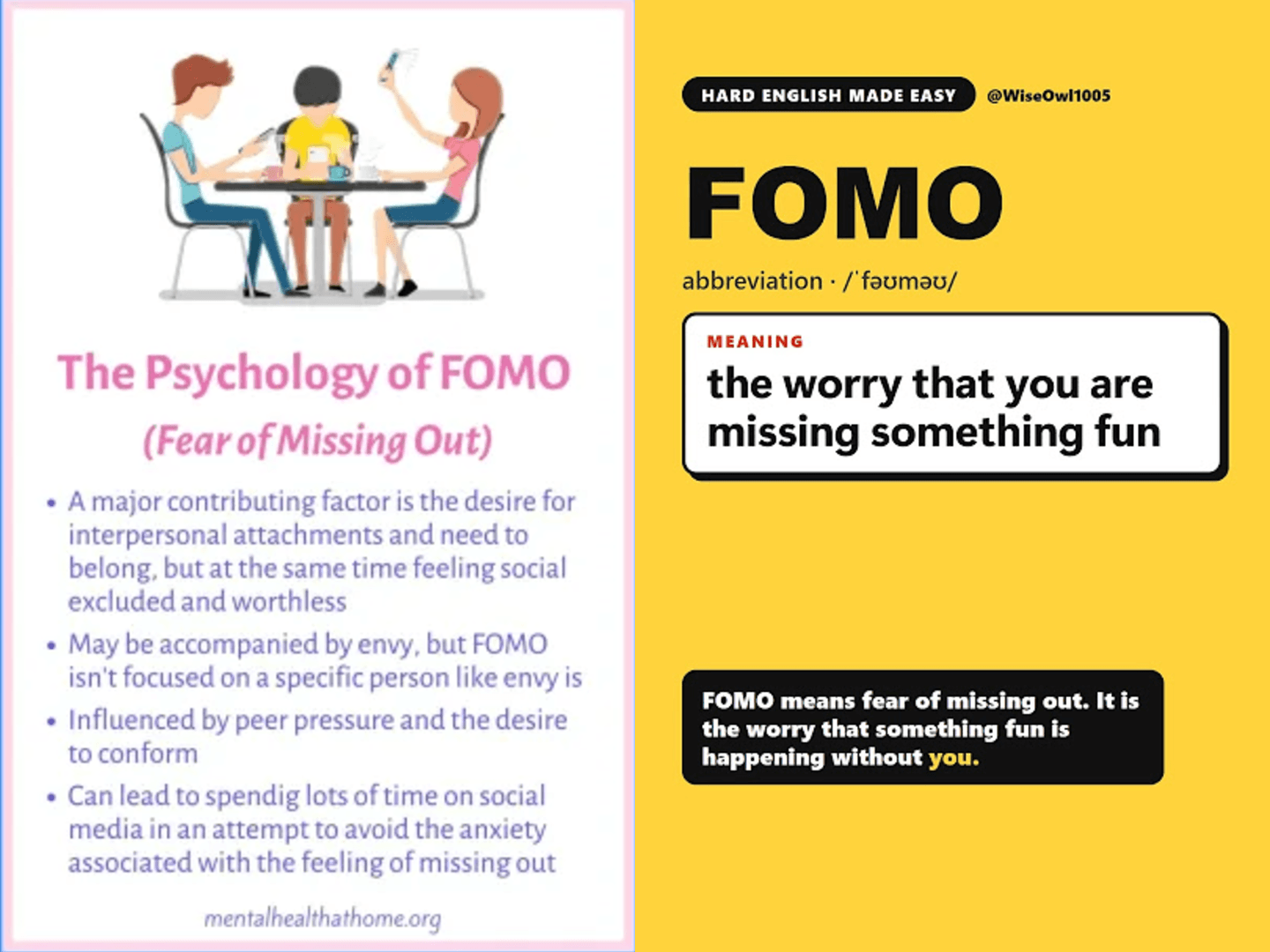
FOMO in text stands for “fear of missing out.” The Oxford Advanced Learner’s Dictionary defines it as “a feeling of worry that an interesting or exciting event is happening somewhere else” . In everyday texting, the fomo meaning in text is simple: it describes the anxiety of feeling excluded from something fun or important that others are experiencing.
The term is used casually as a noun in messages and social media captions. Merriam-Webster defines FOMO as “fear of not being included in something (such as an interesting or enjoyable activity) that others are experiencing” . Someone might text “I have major FOMO” after seeing friends at a concert, or ask “Are you having FOMO?” when making weekend plans.
The word was coined by Patrick McGinnis in a May 2004 humor column for The Harbus, the Harvard Business School student newspaper . McGinnis later told Harvard Business School that he had not realized the phrase would take on a life of its own until a reporter traced it back to him before his 2014 reunion . The term has since entered major dictionaries and become standard vocabulary in digital communication.
FOMO is closely tied to social media behavior. Cleveland Clinic psychologist Susan Albers notes that scrolling through friends’ feeds makes it easy to see what others are doing and feel emotions like sadness, resentment, or jealousy . The comparison is often unfair because people typically post highlights rather than ordinary moments. This gap between curated online lives and real experience fuels the anxious feeling that others are having more fun.
A useful comparison is JOMO, which stands for “joy of missing out.” The BBC Learning English program describes JOMO as enjoying personal time instead of doing something social or checking social media . While FOMO involves worry about exclusion, JOMO involves contentment with choosing to opt out. Albers explains that JOMO means prioritizing self-care and consciously choosing what you want to participate in, not what you feel pressured to participate in .
Important note: The search results conflate at least three different individuals named Patrick McGinnis, including a baseball player, a former Nestlé Purina CEO, and the FOMO coiner. The table above only includes information that TED and Wikipedia attribute to the FOMO creator. Fields marked “Unverified” or “Unavailable” should not be published without further authoritative sourcing.
Not everyone experiences FOMO the same way. BBC Radio 4 reported on a 2013 study by psychologist Andrew Przybylski that found young men showed the highest levels of anxiety about not being part of the group . The research suggested that people who felt less autonomy, competence, and connectedness in daily life were more susceptible to FOMO . This finding helps explain why the term resonates so strongly in text messages, where social plans and group chats can quickly create a sense of being left out.
The word has also moved beyond personal relationships. Merriam-Webster examples show FOMO appearing in financial contexts, such as market behavior driven by “fear of missing out” and algorithmic trading . In these cases, the same psychological mechanism applies: the worry that others are benefiting from an opportunity you are not part of. This flexibility has helped FOMO remain relevant across conversations about social life, investing, and consumer trends.
For anyone encountering the term in a message, the meaning is straightforward. FOMO is not a formal diagnosis or a clinical condition. It is an informal label for a common emotional response, especially in a connected world where other people’s plans and experiences are visible almost instantly. When someone texts “FOMO is real,” they are saying the feeling of being left out is strong in that moment.
The term’s journey from a student humor column to global shorthand for social anxiety reflects how digital communication has changed emotional vocabulary. Patrick McGinnis created a phrase that captured a specific modern discomfort, and dictionaries later validated its staying power . In text messages, FOMO works because it is short, recognizable, and immediately understood by the recipient.
Understanding FOMO also means recognizing when it is shaping decisions. The feeling can motivate people to attend events or stay connected, but it can also lead to overbooking or unnecessary spending. Albers notes that FOMO can sometimes push people out of their comfort zones in positive ways, but the key is awareness of what is driving the choice . A text message saying “I only said yes because of FOMO” is a small admission that the anxiety, not genuine interest, made the decision.
In short, the fomo meaning in text is a compact way to name a familiar feeling. It stands for fear of missing out, it was coined by Patrick McGinnis in 2004, and it describes the worry that something enjoyable is happening without you . The next time a message mentions FOMO, the sender is likely expressing a mix of curiosity, comparison, and the very human desire to belong
What does FOMO mean in text?
FOMO stands for “fear of missing out.” It refers to the anxiety or worry that an interesting or exciting event is happening elsewhere, often triggered by seeing others’ posts on social media . In text messages, it is commonly used to express the feeling of being left out of something fun .
Who coined the term FOMO and when?
The term was popularized by Patrick McGinnis in 2004 through an article for the Harvard Business School community . While the underlying feeling is older, McGinnis is widely credited with turning it into the recognizable acronym used today .
How is FOMO different from JOMO?
JOMO stands for “joy of missing out,” which is essentially the opposite of FOMO. According to the Cleveland Clinic, JOMO is about intentionally opting out of activities to prioritize self-care and contentment, rather than feeling anxious about what others are doing . While FOMO involves worry about exclusion, JOMO involves choosing what you truly want to do without guilt .
Is FOMO a recognized word in dictionaries?
Yes. Major dictionaries including the Oxford Advanced Learner’s Dictionary and Merriam-Webster have officially defined FOMO . Oxford defines it as “a feeling of worry that an interesting or exciting event is happening somewhere else” .
Does research support the idea of FOMO?
Yes. A 2013 study by psychologist Andrew Przybylski and colleagues was the first empirical investigation of FOMO. It found that FOMO levels are highest in young people, particularly young men, and that low levels of psychological need satisfaction are linked to higher FOMO . The research also identified FOMO as a driving force behind social media use .
