
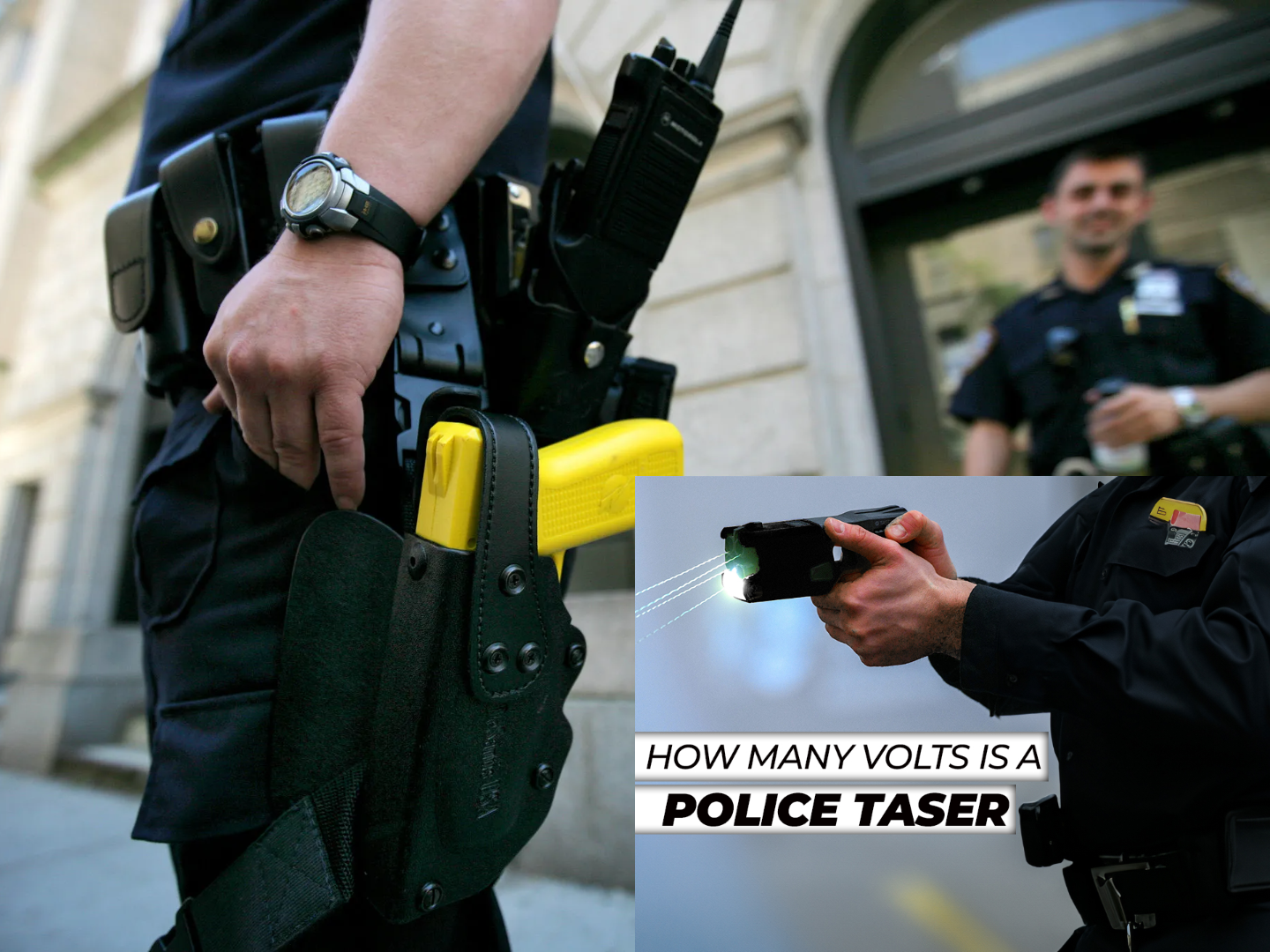
A police taser has two voltage numbers, and the gap between them confuses almost everyone. The initial burst reaches 50,000 volts to jump through clothing and air, but once current flows into a body, the voltage collapses to around 1,200 to 1,500 volts in extremely short pulses.
That massive difference is not a trick. It reflects how the device works: the high open-circuit voltage creates an electrical arc, while the loaded voltage does the actual work of disrupting muscle control.
Why a Taser Needs 50,000 Volts
The TASER X26, deployed by police agencies for roughly two decades, fires two probes attached to thin wires. Thick jackets, loose shirts, or even a small air gap between the probes and skin can block a weaker current from completing the circuit.
The 50,000-volt open-circuit peak solves that problem by arcing across barriers so the connection can be established. This phase lasts only microseconds and is not what locks up a person’s muscles.
Once the circuit is complete and electricity enters the body, the voltage drops sharply. According to technical specifications published for the X26, the peak loaded voltage ranges from 1,400 to 2,520 volts, with a typical value around 1,200 to 1,500 volts in real-world use.
What Actually Reaches the Body
The X26 delivers pulses at roughly 19 per second, with each pulse lasting about 100 microseconds. The average current is only about 2.1 milliamps, and the energy delivered per pulse in a typical load is just 0.07 joules.
That combination of high voltage and minimal current is intentional. The pulses target motor neurons, which control skeletal muscles, causing them to contract uncontrollably and temporarily incapacitate the subject.
Cardiac muscle behaves differently because it has a longer stimulation time constant. The brief pulses are too short to disrupt the heart’s rhythm under normal anatomical conditions, which is why the device is classified as less-lethal rather than lethal.
The Safety Evidence
The National Institute of Justice convened an expert medical panel to review deaths following taser use. The panel examined 300 subdual cases and approximately 175 peer-reviewed articles before issuing its 2011 final report.
The panel concluded there is no conclusive medical evidence indicating a high risk of serious injury or death from short-term taser exposure in healthy, non-stressed, non-intoxicated persons. The risk of death in a taser-related use-of-force incident was estimated at less than 0.25 percent, or one in 400.
A 2008 theoretical analysis published in IEEE noted the possibility of ventricular fibrillation under certain conditions, and a 2014 case report in Circulation documented a death following a chest shot. The NIJ panel acknowledged that rare direct lethality cannot be excluded, though it has not been conclusively demonstrated.Quick Bio Table
Note: Fields marked “Not publicly verified” indicate that no authoritative source was found in the search results. Jack Cover passed away on February 7, 2009 in Mission Viejo, California, from pneumonia brought on by Alzheimer’s disease.
Where the Real Risk Lies
The NIJ panel found the risk of significant injury from tasers to be 0.5 to 0.7 percent. Documented injuries include puncture wounds from the probes and falls that occur when muscle control suddenly stops.
Most deaths following taser use involved individuals who were intoxicated, had underlying medical conditions, or were subjected to prolonged or repeated discharges. The panel recommended limiting applications to the fewest needed and avoiding any single discharge longer than 15 seconds.
Amnesty International has documented cases of misuse and raised concerns about direct-contact mode, which causes intense pain and has been linked to torture allegations. The organization has called for stricter protocols and prohibitions on contact use.
The voltage numbers alone tell an incomplete story. The 50,000-volt figure is real, but it is a design feature for connectivity, not a measure of what a person receives. The energy that reaches the body is brief, low-current, and specifically shaped to incapacitate without stopping the heart under normal conditions.
Does a police taser actually deliver 50,000 volts to the body?
No. The 50,000 volts figure refers to the open-circuit peak needed to arc across clothing and air gaps. Once the circuit is complete and current flows into the body, the voltage drops sharply. A study measuring the TASER X26 on human volunteers found the mean voltage per pulse was 580 volts, with a peak main-phase voltage of approximately 1,899 volts.
How much current does a taser deliver?
The mean current per pulse under a physiologic load is about 0.97 amps, with an average peak main-phase current of 3.10 amps. The device fires at 19 pulses per second, each lasting roughly 100 microseconds. This combination targets skeletal motor neurons while keeping cardiac effects minimal.
What does being tased actually feel like?
Trainees and volunteers consistently describe overwhelming pain and complete loss of muscle control. One Marine who experienced a five-second discharge said it “locks up your entire body, and you can’t bend or do anything. You are pretty much stiff as a board”. An Air Force security forces augmentee described the sensation as muscles contracting from vertebrae to vertebrae, resulting in full-body paralysis during the exposure.
Can a taser affect someone with a pacemaker or implanted defibrillator?
A 2009 review of conducted electrical weapons found that taser discharges may cause oversensing in pacemakers and inappropriate detection of ventricular fibrillation in ICDs, but the standard five-second discharge is too short to produce clinically significant pacing inhibition or inappropriate shocks. A separate 2025 study on handheld electro-shockers found that interaction risk with cardiac implantable electronic devices depends primarily on applied voltage, with higher-voltage devices posing greater risk.
Are there rules limiting how long police can use a taser?
Yes. The National Institute of Justice expert panel recommended limiting discharges to the fewest needed and avoiding any single application longer than 15 seconds. Many police agencies adopt stricter protocols. The Queensland Police Service, for example, defines a standard deployment as a single five-second cycle and requires officers to reassess the situation before any additional cycle.
